AMC 8 · 2025 · #2
Easy mode Grade 4Long ago in ancient Egypt, people wrote numbers with little pictures called hieroglyphs. The table below shows which picture stands for which number.
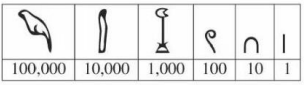
To find the value of a number, you just add up what every picture is worth. For example, the picture group ∩∩∩∣∣ means 32, because three ∩ symbols are worth 10 each and the two ∣ symbols are worth 1 each.
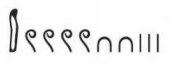
Now look at the picture group below. What number does it show?
Pick an answer.
AMC 8 2025 problem © Mathematical Association of America (MAA AMC). Reproduced for educational use.
Try it yourself first — the explanation is most useful after you’ve attempted it.
Toolkit + CCSS Solution
Understand
Restated: Ancient Egyptian numerals are written by repeating symbols, where each symbol stands for a fixed value (single stroke $= 1$, heel bone $= 10$, coiled rope $= 100$, lotus flower $= 1{,}000$, bent finger $= 10{,}000$, and so on). The system is additive, not positional — the number is the sum of the values of all the symbols shown. Given a combination of $1$ bent finger, $4$ coiled ropes, $2$ heel bones, and $3$ single strokes, find the number it represents and match it to one of the five choices.
Givens: Bent finger $= 10{,}000$; coiled rope $= 100$; heel bone $= 10$; single stroke $= 1$ (from the reference table); Example: $\cap\cap\cap||$ (three heel bones and two strokes) represents $32$, confirming the additive rule; Symbols shown in the target combination: $1$ bent finger, $4$ coiled ropes, $2$ heel bones, $3$ single strokes; Answer choices: (A) $1{,}423$, (B) $10{,}423$, (C) $14{,}023$, (D) $14{,}203$, (E) $14{,}230$
Unknowns: The base-$10$ number represented by the given hieroglyph combination, matched to choice (A)-(E)
Understand
Restated: Ancient Egyptian numerals are written by repeating symbols, where each symbol stands for a fixed value (single stroke $= 1$, heel bone $= 10$, coiled rope $= 100$, lotus flower $= 1{,}000$, bent finger $= 10{,}000$, and so on). The system is additive, not positional — the number is the sum of the values of all the symbols shown. Given a combination of $1$ bent finger, $4$ coiled ropes, $2$ heel bones, and $3$ single strokes, find the number it represents and match it to one of the five choices.
Givens: Bent finger $= 10{,}000$; coiled rope $= 100$; heel bone $= 10$; single stroke $= 1$ (from the reference table); Example: $\cap\cap\cap||$ (three heel bones and two strokes) represents $32$, confirming the additive rule; Symbols shown in the target combination: $1$ bent finger, $4$ coiled ropes, $2$ heel bones, $3$ single strokes; Answer choices: (A) $1{,}423$, (B) $10{,}423$, (C) $14{,}023$, (D) $14{,}203$, (E) $14{,}230$
Plan
Primary tool: #2 Make a Systematic List
Secondary: #3 Eliminate Possibilities
The cleanest path is Tool #2 (Systematic List): walk through the four distinct symbol types from largest value to smallest, tally how many of each appear, and multiply count $\times$ value. Because the Egyptian system is additive, the answer is just the sum of these four products — no place-value juggling needed. Tool #3 (Eliminate Possibilities) is a great second pass for multiple-choice: the absence of the lotus flower ($1{,}000$) forces the thousands digit to be $0$, which alone narrows the five choices down to (B) $10{,}423$, giving us an independent check on our computation.
Execute — Answer: B
K.MD.B.3 Step 1 - Sort the symbols by value (largest to smallest) and record how many of each appear in the given combination.
- Listing them in this fixed order means we don't miss or double-count any group.
💡 Sorting objects into the right buckets and counting each bucket is a Kindergarten classify-and-count move.
3.NBT.A.3 Step 2 - Multiply each count by the value of its symbol.
- Each product is just a count times a power of $10$, which is one of the easiest multiplications you can do — just write the count followed by the right number of zeros.
💡 Multiplying a one-digit number by $10$, $100$, or $10{,}000$ is the Grade 3 "multiples of $10$" pattern — just attach the zeros.
4.NBT.B.4 Step 3 - Add the four partial values together.
- Because no two of these numbers ever share a non-zero digit in the same place, the addition has no carries — you can simply slot each value into its own place in the final answer.
💡 Fluently adding multi-digit whole numbers up to the ten-thousands place is a Grade 4 standard.
4.NBT.A.2 Step 4 - Match the total to the answer choices.
- Cross-check with Tool #3 (Eliminate): the bent finger is present, so the number is at least $10{,}000$ (kills (A)); there is no lotus flower, so the thousands digit must be $0$ (kills (C), (D), (E)).
- Only (B) $10{,}423$ survives — agreeing with the direct sum.
💡 Reading a five-digit number and comparing it to the choices uses Grade 4 multi-digit place-value understanding.
K.MD.B.3 Sort the symbols by value (largest to smallest) and record how many of each appe 3.NBT.A.3 Multiply each count by the value of its symbol. Each product is just a count tim 4.NBT.B.4 Add the four partial values together. Because no two of these numbers ever share 4.NBT.A.2 Match the total to the answer choices. Cross-check with Tool #3 (Eliminate): the Review
Reasonableness: The bent finger contributes $10{,}000$, so the answer must be at least $10{,}000$ — that immediately rules out (A) $1{,}423$. There are no lotus flowers (worth $1{,}000$ each), so the thousands place must be $0$, which fits $10{,}423$ but not any of $14{,}023$, $14{,}203$, $14{,}230$. The hundreds digit comes from $4$ ropes ($= 400$), the tens digit from $2$ heel bones ($= 20$), and the ones digit from $3$ strokes ($= 3$); reading the answer left-to-right as $1,\;0,\;4,\;2,\;3$ matches $10{,}423$ digit by digit.
Alternative: Tool #3 (Eliminate Possibilities) alone solves it without any arithmetic: "bent finger present" forces the number to be in the ten-thousands, killing (A); "no lotus flower" forces the thousands digit to $0$, killing (C), (D), (E). Only (B) survives — a pure elimination route that exploits the multiple-choice format.
CCSS standards used (min grade 4)
K.MD.B.3Classify objects into given categories and count the numbers in each (Sorting the symbols into four buckets (bent finger, coiled rope, heel bone, single stroke) and counting how many appear in each.)3.NBT.A.3Multiply one-digit whole numbers by multiples of 10 (Computing $4 \times 100 = 400$, $2 \times 10 = 20$, and the analogous one-digit-times-power-of-$10$ products for each symbol group.)4.NBT.B.4Fluently add and subtract multi-digit whole numbers (Adding $10{,}000 + 400 + 20 + 3 = 10{,}423$ to get the total value of the hieroglyph combination.)4.NBT.A.2Read and write multi-digit whole numbers and compare using symbols (Reading the five-digit result $10{,}423$ and matching it against the five-digit choices (A)-(E).)
⭐ This AMC 8 problem only needs Grade 4 place value and multi-digit addition you already know!
⭐ This AMC 8 problem only needs Grade 4 place value and multi-digit addition you already know!
More like this
Same archetype — closest grade level first.
