AMC 10 · 2024 · #22
Grade 8 geometry-2dProblem
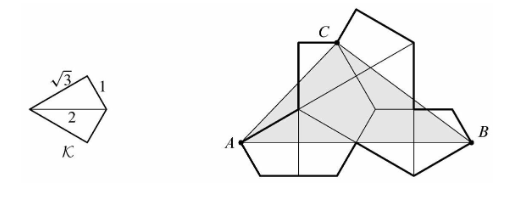
Let be the kite formed by joining two right triangles with legs and along a common hypotenuse. Eight copies of are used to form the polygon shown below. What is the area of triangle ?

Pick an answer.
Toolkit + CCSS Solution
Understand
Restated: A kite $\mathcal K$ is built from two right triangles with legs $1$ and $\sqrt{3}$ glued along their common hypotenuse. Eight copies of $\mathcal K$ tile a polygon, and a large triangle $\triangle ABC$ is drawn on the tiling. Find the area of $\triangle ABC$.
Givens: Each half of the kite is a right triangle with legs $1$ and $\sqrt{3}$; The two right triangles share their hypotenuse, which becomes a diagonal of the kite; $8$ kites tile the polygon shown; $\triangle ABC$ is the large triangle marked in the figure; Answer choices: (A) $2+3\sqrt{3}$, (B) $\tfrac{9}{2}\sqrt{3}$, (C) $\tfrac{10+8\sqrt{3}}{3}$, (D) $8$, (E) $5\sqrt{3}$
Unknowns: The area of $\triangle ABC$
Understand
Restated: A kite $\mathcal K$ is built from two right triangles with legs $1$ and $\sqrt{3}$ glued along their common hypotenuse. Eight copies of $\mathcal K$ tile a polygon, and a large triangle $\triangle ABC$ is drawn on the tiling. Find the area of $\triangle ABC$.
Givens: Each half of the kite is a right triangle with legs $1$ and $\sqrt{3}$; The two right triangles share their hypotenuse, which becomes a diagonal of the kite; $8$ kites tile the polygon shown; $\triangle ABC$ is the large triangle marked in the figure; Answer choices: (A) $2+3\sqrt{3}$, (B) $\tfrac{9}{2}\sqrt{3}$, (C) $\tfrac{10+8\sqrt{3}}{3}$, (D) $8$, (E) $5\sqrt{3}$
Plan
Primary tool: #1 Draw a Diagram
Secondary: #7 Identify Subproblems
The whole problem lives inside one picture, so Tool #1 (Draw a Diagram) drives everything: re-mark the figure with the kite's actual side lengths ($1, 1, \sqrt{3}, \sqrt{3}$) and angles, and the tiling tells you exactly how $AB$ and the altitude to $AB$ are built from kite edges. Tool #7 (Identify Subproblems) then splits "area of $\triangle ABC$" into two independent measurements — base $AB$ and height $h$ from $C$ — each of which is a short Pythagorean-theorem calculation on one small piece of the tiling. With base and height in hand, the final area is one Grade 6 formula.
Execute — Answer: B
8.G.B.7 Step 1 - Pin down the kite's geometry first.
- Each half is a right triangle with legs $1$ and $\sqrt{3}$.
- By the Pythagorean theorem the shared hypotenuse has length $\sqrt{1^2 + (\sqrt{3})^2} = \sqrt{4} = 2$.
- So the kite has four sides $1, 1, \sqrt{3}, \sqrt{3}$, one diagonal of length $2$ (the shared hypotenuse), and two right angles where the legs meet.
- Mark these on the figure.
💡 Grade 8 Pythagorean theorem on the simplest possible right triangle — the legs are already given.
6.G.A.1 Step 2 - Identify the two pieces of $\triangle ABC$ we still need: the base $AB$ and the height $h$ from $C$ to $AB$.
- By the left-right symmetry of the tiling, the foot of the altitude lands at the midpoint of $AB$, and both halves of $AB$ look the same.
- So measuring half of $AB$ and the height $h$ is enough — that is the subproblem split.
💡 Grade 6 area-of-triangle formula tells us exactly which two numbers to chase — no more, no less.
8.G.A.4 Step 3 - Measure the base $AB$ from the tiling.
- Reading the figure, $AB$ is made of four equal horizontal segments, and each segment is the horizontal projection of one $\sqrt{3}$-side of a kite.
- That $\sqrt{3}$-side together with the horizontal segment and a short vertical segment forms a small right triangle similar to the original $1:\sqrt{3}:2$ triangle (it has the same angles), but scaled so its hypotenuse is $\sqrt{3}$ instead of $2$.
- The scale factor is $\sqrt{3}/2$, so the small triangle's legs are $\sqrt{3}/2 \cdot 1 = \sqrt{3}/2$ and $\sqrt{3}/2 \cdot \sqrt{3} = 3/2$.
- The horizontal leg (the one along $AB$) is the longer one: $3/2$.
💡 Grade 8 similar figures: same angles means sides scale by one common factor — here $\sqrt{3}/2$, the ratio of the new hypotenuse to the original.
7.NS.A.1 Step 4 - Measure the height $h$ the same way.
- The altitude from $C$ runs through two stacked pieces of the tiling: (i) the vertical leg of one of those small similar triangles, contributing $\sqrt{3}/2$, and (ii) a $\sqrt{3}$-side of a kite sitting directly above, oriented vertically, contributing $\sqrt{3}$.
- Add them.
💡 Grade 7 rational arithmetic — same as adding $1 + \tfrac{1}{2} = \tfrac{3}{2}$, only with the common factor $\sqrt{3}$ along for the ride.
6.G.A.1 Step 5 Plug base and height into the area formula.
💡 Grade 6 closing move: with base and height in hand, multiply and halve.
8.G.B.7 Pin down the kite's geometry first. Each half is a right triangle with legs $1$ 6.G.A.1 Identify the two pieces of $\triangle ABC$ we still need: the base $AB$ and the 8.G.A.4 Measure the base $AB$ from the tiling. Reading the figure, $AB$ is made of four 7.NS.A.1 Measure the height $h$ the same way. The altitude from $C$ runs through two stac 6.G.A.1 Plug base and height into the area formula. Review
Reasonableness: Sanity check the total tiled area. One kite is two right triangles of legs $1$ and $\sqrt{3}$, so its area is $2 \cdot \tfrac{1}{2} \cdot 1 \cdot \sqrt{3} = \sqrt{3}$, and the eight-kite polygon has area $8\sqrt{3} \approx 13.86$. Our $\triangle ABC$ has area $\tfrac{9\sqrt{3}}{2} \approx 7.79$, which is well under the whole polygon and consistent with the figure (the triangle clearly covers more than half but not all of it). The numerical value $7.79$ matches choice (B) exactly.
Alternative: Tool #3 (Eliminate Possibilities): convert each choice to a decimal — (A) $2 + 3\sqrt{3} \approx 7.20$, (B) $\tfrac{9\sqrt{3}}{2} \approx 7.79$, (C) $\tfrac{10+8\sqrt{3}}{3} \approx 8.95$, (D) $8$, (E) $5\sqrt{3} \approx 8.66$. Once the diagram gives $AB = 6$, the height $h$ is at least $\sqrt{3}$ (one vertical kite side) and at most $2\sqrt{3}$ (two stacked), so the area lies between $3\sqrt{3} \approx 5.2$ and $6\sqrt{3} \approx 10.4$. All five choices survive that crude window, but pinning $h = \tfrac{3\sqrt{3}}{2}$ from the tiling — one full kite side plus one half-side — selects (B) uniquely.
CCSS standards used (min grade 8)
8.G.B.7Apply the Pythagorean Theorem to determine unknown side lengths in right triangles in real-world and mathematical problems (Computing the shared hypotenuse of the kite's two half-triangles, $\sqrt{1^2 + (\sqrt{3})^2} = 2$, which fixes the kite's diagonal and confirms all side and diagonal lengths used later.)8.G.A.4Understand that a two-dimensional figure is similar to another if one can be obtained from the other by a sequence of rotations, reflections, translations, and dilations (Recognizing that the small right triangle formed at the base of the tiling has the same angles as the kite's half-triangle and is therefore a similar copy scaled by $\sqrt{3}/2$, giving its legs $\sqrt{3}/2$ and $3/2$.)7.NS.A.1Apply and extend previous understandings of addition and subtraction to add and subtract rational numbers (Adding the two vertical pieces of the altitude, $\sqrt{3} + \tfrac{\sqrt{3}}{2} = \tfrac{3\sqrt{3}}{2}$, with the irrational factor $\sqrt{3}$ treated as a common unit.)6.G.A.1Find the area of right triangles, other triangles, and special quadrilaterals by composing or decomposing into shapes (Applying $[\triangle ABC] = \tfrac{1}{2} \cdot AB \cdot h = \tfrac{1}{2} \cdot 6 \cdot \tfrac{3\sqrt{3}}{2} = \tfrac{9\sqrt{3}}{2}$ to finish.)
⭐ When a figure is tiled by repeated pieces, label one piece carefully and use similar-triangle scaling to read the base and height of the big triangle straight off the picture — then $\tfrac{1}{2} \cdot \text{base} \cdot \text{height}$ closes it out.