AMC 8 · 2022 · #25
Grade 7 probabilitycountingProblem
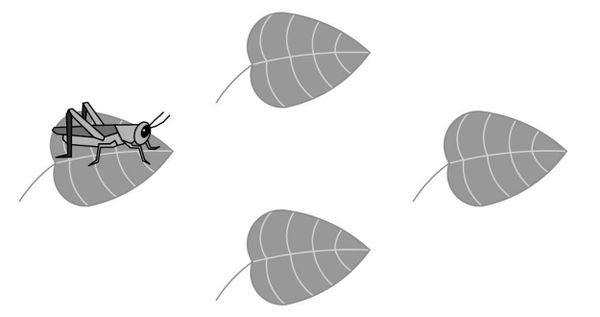
A cricket randomly hops between leaves, on each turn hopping to one of the other leaves with equal probability. After hops what is the probability that the cricket has returned to the leaf where it started?
![]()
Pick an answer.
Toolkit + CCSS Solution
Understand
Restated: A cricket sits on one of $4$ leaves. Each turn it jumps to one of the other $3$ leaves, chosen uniformly at random. After exactly $4$ jumps, what is the probability that it is back on the leaf it started from?
Givens: There are $4$ leaves; call the starting leaf $A$ and the others $B$, $C$, $D$; Each jump goes to one of the $3$ other leaves with equal probability $\tfrac{1}{3}$; The cricket makes exactly $4$ jumps; Answer choices: (A) $\tfrac{2}{9}$, (B) $\tfrac{19}{80}$, (C) $\tfrac{20}{81}$, (D) $\tfrac{1}{4}$, (E) $\tfrac{7}{27}$
Unknowns: The probability $p_4$ that the cricket is on leaf $A$ after $4$ jumps
Understand
Restated: A cricket sits on one of $4$ leaves. Each turn it jumps to one of the other $3$ leaves, chosen uniformly at random. After exactly $4$ jumps, what is the probability that it is back on the leaf it started from?
Givens: There are $4$ leaves; call the starting leaf $A$ and the others $B$, $C$, $D$; Each jump goes to one of the $3$ other leaves with equal probability $\tfrac{1}{3}$; The cricket makes exactly $4$ jumps; Answer choices: (A) $\tfrac{2}{9}$, (B) $\tfrac{19}{80}$, (C) $\tfrac{20}{81}$, (D) $\tfrac{1}{4}$, (E) $\tfrac{7}{27}$
Plan
Primary tool: #9 Solve an Easier Related Problem
Secondary: #5 Look for a Pattern, #1 Draw a Diagram
Going from $4$ jumps to the answer in one shot is hard, but going from $n$ jumps to $n+1$ jumps is easy — that is exactly Tool #9 (Solve an Easier Related Problem) applied to the time variable. Use Tool #1 (Draw a Diagram) to picture the $4$ leaves with edges between every pair ($K_4$); the picture makes the symmetry obvious — leaves $B$, $C$, $D$ are interchangeable, so they always share the same probability $q_n$ of holding the cricket after $n$ jumps. That symmetry collapses $4$ unknowns down to just two ($p_n$ for leaf $A$ and $q_n$ for any other leaf), and Tool #5 (Look for a Pattern) then turns the problem into a tiny one-step recursion that we run for $n=1,2,3,4$.
Execute — Answer: E
7.SP.C.7 Step 1 - Draw the setup.
- Put leaves $A$, $B$, $C$, $D$ at the four corners of a square (or tetrahedron) and connect every pair with a line — that is the graph $K_4$.
- From any leaf the cricket has exactly $3$ outgoing edges, each used with probability $\tfrac{1}{3}$.
- Because $B$, $C$, $D$ are connected to $A$ and to each other in the same way, they are symmetric.
💡 Drawing $K_4$ shows that all non-$A$ leaves play the same role, so we only need two numbers to track the cricket: "on $A$" or "on one of the others."
7.SP.C.7 Step 2 - Define the two state probabilities after $n$ jumps: $p_n =$ probability of being on $A$, and $q_n =$ probability of being on any one specific non-$A$ leaf.
- By symmetry the three non-$A$ probabilities are equal, so the total probability adds to $p_n + 3 q_n = 1$.
💡 Collapsing the four leaves into the two cases "on $A$" / "on a typical other" is the Tool #9 move: the easier related problem has only $2$ states instead of $4$.
5.NF.B.4 Step 3 - Write the one-step recurrence.
- To land on $A$ after the next jump, the cricket must currently be on one of $B$, $C$, $D$ (total probability $3 q_n$) and then choose $A$ (probability $\tfrac{1}{3}$), giving $p_{n+1} = 3 q_n \cdot \tfrac{1}{3} = q_n$.
- To land on a specific non-$A$ leaf, say $B$, either you were on $A$ and jumped to $B$ (chance $p_n \cdot \tfrac{1}{3}$) or you were on $C$ or $D$ and jumped to $B$ (chance $2 q_n \cdot \tfrac{1}{3}$).
💡 Each rule just adds up "chance of being there" $\times$ "chance of jumping here" — Grade 5 fraction-times-fraction reasoning.
5.NF.A.1 Step 4 - Run the recurrence for $n = 1, 2, 3, 4$, starting from $p_0 = 1$, $q_0 = 0$.
- After each step, check that $p_n + 3 q_n = 1$.
💡 Adding fractions like $\tfrac{1}{3} + \tfrac{4}{9} = \tfrac{7}{9}$ is exactly the Grade 5 "unlike denominators" skill repeated four times.
7.SP.C.8 Step 5 - Read off the answer.
- After $4$ jumps the probability the cricket is back on its starting leaf $A$ is $p_4 = \tfrac{7}{27}$, which matches choice (E).
💡 Compound-event probability over $4$ jumps lands cleanly on a fraction in the answer list — Grade 7 probability of multi-step events.
7.SP.C.7 Draw the setup. Put leaves $A$, $B$, $C$, $D$ at the four corners of a square (o 7.SP.C.7 Define the two state probabilities after $n$ jumps: $p_n =$ probability of being 5.NF.B.4 Write the one-step recurrence. To land on $A$ after the next jump, the cricket m 5.NF.A.1 Run the recurrence for $n = 1, 2, 3, 4$, starting from $p_0 = 1$, $q_0 = 0$. Aft 7.SP.C.8 Read off the answer. After $4$ jumps the probability the cricket is back on its Review
Reasonableness: Sanity check 1: $p_n + 3 q_n = 1$ at every step (e.g. $\tfrac{7}{27} + 3 \cdot \tfrac{20}{81} = \tfrac{21}{81} + \tfrac{60}{81} = 1$). Sanity check 2: if jumps were random over all $4$ leaves (including staying), the long-run probability of being on $A$ would be $\tfrac{1}{4} = 0.25$. Our answer $\tfrac{7}{27} \approx 0.259$ is just slightly above $\tfrac{1}{4}$, which makes sense because $4$ is an even number of jumps and the cricket is forced to move each turn, very slightly biasing it back toward $A$. Choices (A) $\tfrac{2}{9} \approx 0.222$ and (D) $\tfrac{1}{4} = 0.25$ are too low; (B) $\tfrac{19}{80}$ has the wrong denominator family (should involve $3^n$). Only (E) fits.
Alternative: Tool #2 (Systematic List) with Tool #7 (Identify Subproblems): the total number of $4$-jump sequences is $3^4 = 81$. List the successful ones by splitting on whether jump $2$ returns to $A$. Case 1 ($A \to X \to A \to Y \to A$): $3 \cdot 3 = 9$ sequences. Case 2 ($A \to X \to Y \to Z \to A$ with $Y \ne A$): $3 \cdot 2 \cdot 2 = 12$ sequences ($3$ choices for $X$, $2$ choices for $Y \ne A$, and $Z$ must be a non-$A$ neighbor of $A$ different from $Y$, which gives $2$ choices). Total successful $= 9 + 12 = 21$, so probability $= \tfrac{21}{81} = \tfrac{7}{27}$.
CCSS standards used (min grade 7)
5.NF.A.1Add and subtract fractions with unlike denominators (Computing recurrence sums like $\tfrac{1}{3} + \tfrac{4}{9} = \tfrac{3}{9} + \tfrac{4}{9} = \tfrac{7}{9}$ at each step.)5.NF.B.4Apply and extend understanding of multiplication to multiply a fraction by a fraction (Multiplying "chance of being on a leaf" by "chance of jumping to a target" — e.g. $q_n \cdot \tfrac{1}{3}$ — to build $p_{n+1}$ and $q_{n+1}$.)7.SP.C.7Develop probability models and use them to find probabilities of events (Setting up the symmetric two-state probability model ($p_n$ for leaf $A$, $q_n$ for any other leaf) for the cricket on $K_4$.)7.SP.C.8Find probabilities of compound events using organized lists, tables, and simulation (Combining $4$ jumps into a single compound-event probability $p_4 = \tfrac{7}{27}$.)
⭐ This AMC 8 problem only needs Grade 7 compound-event probability — "chance of step 1 times chance of step 2 times..." — that you already know!