AMC 8 · 2024 · #6

Grade 2 arithmetic
perimeterspatial-visualization path-length-comparison ↑ Prerequisites: perimetermental-arithmetic
📏 Medium solution 💡 3 insights 📊 Diagram
📘 View easy version →

Problem

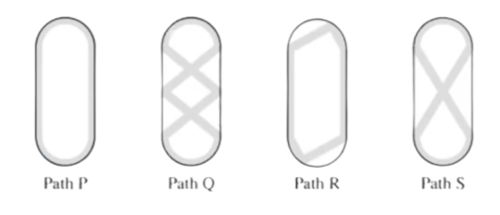
Sergai skated around an ice rink, gliding along different paths. The gray lines in the figures below show four of the paths labeled P, Q, R, and S. What is the sorted order of the four paths from shortest to longest?

figure

Pick an answer.

(A)
P,Q,R,S
(B)
P,R,S,Q
(C)
Q,S,P,R
(D)
R,P,S,Q
(E)
R,S,P,Q
View mode:

Toolkit + CCSS Solution

Understand

Restated: An ice rink (a long shape made of a rectangle with two semicircular ends) is shown with four skating paths drawn on it. Path P traces the outer boundary. Path R is a rectangle inscribed inside the rink, using straight vertical chords where P uses semicircular arcs. Path S is made of two long diagonals that cross in the middle. Path Q is a zig-zag path that crosses the rink with extra horizontal detours. We must order P, Q, R, S from shortest to longest.

Givens: Path P = outer boundary of the rink: two long horizontal straight segments plus two semicircular arcs at the ends; Path R = inscribed rectangle: the SAME two long horizontal segments as P, but the arc-ends of P are replaced by two short straight vertical chords; Path S = two long diagonals from corner to corner of the rink's central rectangle, crossing in the middle; Path Q = a zig-zag that starts like a diagonal but takes horizontal detours before finishing the crossing; Five answer choices listing different orderings of P, Q, R, S

Unknowns: The single ordering of the four paths from shortest length to longest length

Understand

Restated: An ice rink (a long shape made of a rectangle with two semicircular ends) is shown with four skating paths drawn on it. Path P traces the outer boundary. Path R is a rectangle inscribed inside the rink, using straight vertical chords where P uses semicircular arcs. Path S is made of two long diagonals that cross in the middle. Path Q is a zig-zag path that crosses the rink with extra horizontal detours. We must order P, Q, R, S from shortest to longest.

Givens: Path P = outer boundary of the rink: two long horizontal straight segments plus two semicircular arcs at the ends; Path R = inscribed rectangle: the SAME two long horizontal segments as P, but the arc-ends of P are replaced by two short straight vertical chords; Path S = two long diagonals from corner to corner of the rink's central rectangle, crossing in the middle; Path Q = a zig-zag that starts like a diagonal but takes horizontal detours before finishing the crossing; Five answer choices listing different orderings of P, Q, R, S

Plan

Primary tool: #1 Draw a Diagram

Secondary: #7 Identify Subproblems, #3 Eliminate Possibilities

The whole problem IS a picture, so Tool #1 (Diagram) is unavoidable — we work directly on the figure, looking for which segments of one path match segments of another. Comparing four paths at once is hard, so we use Tool #7 (Subproblems) to break the task into three easy pairwise comparisons: (R vs P), (S vs Q), and (P vs S). Each pairwise comparison is a one-line observation about straight-vs-curved or straight-vs-zigzag. Finally, we use Tool #3 (Eliminate Possibilities) on the five answer choices: each inequality we prove rules out the choices that violate it, and only one option survives. No algebra, no measurements, no formulas — just looking at the picture carefully.

Execute — Answer: D

#1 Draw a Diagram K.MD.A.2 Step 1
  • Look at paths R and P side by side.
  • Their two long horizontal pieces are IDENTICAL.
  • The only difference is at the two ends: P uses curved semicircles, R uses straight vertical chords joining the same endpoints.
  • Since a straight line between two points is shorter than any curved arc between the same two points, R is shorter than P.
$$\text{straight chord} < \text{arc with same endpoints} \Rightarrow R < P$$

💡 Even Kindergartners can put two lines next to each other and see which one is longer.

#1 Draw a Diagram K.MD.A.2 Step 2
  • Now compare paths S and Q on the figure.
  • Path S is two straight diagonals from corner to corner.
  • Path Q starts off like a diagonal but then makes a horizontal sidestep before finishing — it is a zig-zag instead of a straight shot.
  • A zig-zag between two points is always longer than the straight path between those same two points, so S is shorter than Q.
$$\text{straight diagonal} < \text{zig-zag with same endpoints} \Rightarrow S < Q$$

💡 Pulling a zig-zag string straight makes it longer — kids see this just by looking.

#1 Draw a Diagram 2.G.A.1 Step 3
  • We now know R < P and S < Q, so R is one of the shortest two and Q is the longest.
  • To finish, we only have to decide where P and S sit.
  • Path P goes around the perimeter once.
  • Path S crosses the long direction of the rink TWICE (each diagonal is roughly the length of the rink).
  • Drawing this on the figure, the two long diagonals stack up to clearly more than the perimeter loop, so P is shorter than S.
$$P < S$$

💡 Recognizing a rectangle's perimeter vs. its diagonals is a Grade 2 shape-attribute skill.

#7 Identify Subproblems 1.MD.A.1 Step 4
  • Use Tool #7 to combine the three comparisons we just made into one chain.
  • From R < P, P < S, and S < Q we get R < P < S < Q.
  • This is the indirect length-ordering idea from Grade 1: if A is shorter than B and B is shorter than C, then A is shorter than C.
$$R < P,\ P < S,\ S < Q \Rightarrow R < P < S < Q$$

💡 Stacking small comparisons into a single order is exactly what 'order three objects by length' teaches.

#3 Eliminate Possibilities 1.MD.A.1 Step 5
  • Use Tool #3 to match our ordering against the answer choices.
  • We need 'shortest to longest' = R, P, S, Q.
  • Choice (A) P,Q,R,S puts P first — wrong.
  • Choice (B) P,R,S,Q puts P before R — wrong.
  • Choice (C) Q,S,P,R puts Q first — wrong.
  • Choice (E) R,S,P,Q puts S before P — wrong.
  • Only Choice (D) R, P, S, Q matches.
$$\text{Order} = R, P, S, Q \Rightarrow \textbf{(D)}$$

💡 Once the order is known, picking the matching choice is straight Grade 1 length-ordering.

[1] #1 K.MD.A.2 Look at paths R and P side by side. Their two long horizontal pieces are IDENTIC
[2] #1 K.MD.A.2 Now compare paths S and Q on the figure. Path S is two straight diagonals from c
[3] #1 2.G.A.1 We now know R < P and S < Q, so R is one of the shortest two and Q is the longes
[4] #7 1.MD.A.1 Use Tool #7 to combine the three comparisons we just made into one chain. From R
[5] #3 1.MD.A.1 Use Tool #3 to match our ordering against the answer choices. We need 'shortest

Review

Reasonableness: Each pairwise step relied on a single solid rule: the straight path between two points is the shortest. R beats P at the ends (straight chord vs arc); S beats Q in the middle (straight diagonal vs zig-zag); and P beats S overall because one trip around the perimeter is shorter than two full diagonal crossings of a long rink. Combining R < P < S < Q gives exactly one of the listed orderings — choice (D) — which matches the official answer.

Alternative: Tool #10 (Create a Physical Representation) works just as well: cut four pieces of string equal in length to each path on a copy of the figure, then lay them straight side by side and compare. A young learner who can't yet articulate the 'straight is shortest' rule can still discover R < P < S < Q by hand.

CCSS standards used (min grade 2)

  • K.MD.A.2 Directly compare two objects with a measurable attribute in common (Pairwise comparisons R vs P and S vs Q done by looking directly at the figure.)
  • 1.MD.A.1 Order three objects by length and compare lengths indirectly (Chaining the three pairwise inequalities into the single ordering R < P < S < Q and matching it to a choice.)
  • 2.G.A.1 Recognize and draw shapes having specified attributes (Recognizing the rink's straight segments, semicircular arcs, rectangle, and diagonals as distinct shape attributes so we can compare like with like.)

⭐ This AMC 8 problem only needs Grade 2 shape recognition and length comparison you already know!

⭐ This AMC 8 problem only needs Grade 2 shape recognition and length comparison you already know!