AMC 8 · 2025 · #8
Grade 8 geometry-3dProblem
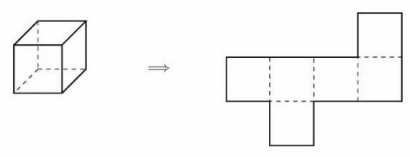
Isaiah cuts open a cardboard cube along some of its edges to form the flat shape shown on the right, which has an area of square centimeters. What is the volume of the cube in cubic centimeters?
Pick an answer.
Toolkit + CCSS Solution
Understand
Restated: Isaiah cuts a cardboard cube open along some of its edges and flattens it into a single connected shape (a net). That flat shape has total area $18$ square centimeters. Find the volume of the original cube in cubic centimeters.
Givens: The flat shape is the net of a cube — every face of the cube appears exactly once; A cube has $6$ congruent square faces; Total area of the net $= 18 \text{ cm}^2$; Answer choices: (A) $3\sqrt{3}$, (B) $6$, (C) $9$, (D) $6\sqrt{3}$, (E) $9\sqrt{3}$ (cm$^3$)
Unknowns: The volume $V$ of the cube, in cubic centimeters
Understand
Restated: Isaiah cuts a cardboard cube open along some of its edges and flattens it into a single connected shape (a net). That flat shape has total area $18$ square centimeters. Find the volume of the original cube in cubic centimeters.
Givens: The flat shape is the net of a cube — every face of the cube appears exactly once; A cube has $6$ congruent square faces; Total area of the net $= 18 \text{ cm}^2$; Answer choices: (A) $3\sqrt{3}$, (B) $6$, (C) $9$, (D) $6\sqrt{3}$, (E) $9\sqrt{3}$ (cm$^3$)
Plan
Primary tool: #17 Visualize Spatial Relationships
Secondary: #7 Identify Subproblems, #8 Analyze the Units
The picture is a flat net, but the question asks about a 3D volume — Tool #17 (Visualize Spatial Relationships) is the bridge: mentally re-fold the net into the cube to see that the flat area is exactly the cube's surface area (no overlap, no gaps). From there Tool #7 (Identify Subproblems) splits the work into a clean chain: (a) total surface area $\to$ area of one face, (b) area of one face $\to$ side length $s$, (c) side length $\to$ volume $V = s^3$. Tool #8 (Analyze the Units) keeps us honest as the units march from cm$^2$ (area) down to cm (length) and up to cm$^3$ (volume).
Execute — Answer: A
6.G.A.4 Step 1 - Re-fold the net mentally.
- The flat shape was cut along some edges and laid flat without overlapping, so the outside of the cube is exactly covered once by the $6$ square faces of the net.
- This means the area of the flat shape equals the cube's surface area.
💡 Folding a flat net into a 3D figure preserves area — that is exactly the Grade 6 "nets and surface area" idea.
3.OA.A.3 Step 2 - Subproblem 1: find the area of a single face.
- The cube has $6$ congruent square faces, so divide the total surface area by $6$.
💡 Splitting one big equal-shares quantity into $6$ identical pieces is a Grade 3 division word problem.
8.EE.A.2 Step 3 - Subproblem 2: turn the face area into a side length.
- Each face is a square, so its area equals (side)$^2$.
- To go from area back to side, take the square root.
💡 Recovering the side of a square from its area uses the Grade 8 square-root symbol — and $\sqrt{3}$ is an irrational number we keep in exact form.
8.EE.A.2 Step 4 - Subproblem 3: turn the side length into the cube's volume using $V = s^3$.
- Multiply $\sqrt{3}$ by itself three times; pair two copies to get $3$, then multiply the leftover $\sqrt{3}$.
💡 Cubing a length cm gives cm$^3$, and using $\sqrt{3}\cdot\sqrt{3}=3$ is the Grade 8 square-root rule.
6.G.A.4 Re-fold the net mentally. The flat shape was cut along some edges and laid flat 3.OA.A.3 Subproblem 1: find the area of a single face. The cube has $6$ congruent square 8.EE.A.2 Subproblem 2: turn the face area into a side length. Each face is a square, so i 8.EE.A.2 Subproblem 3: turn the side length into the cube's volume using $V = s^3$. Multi Review
Reasonableness: Quick estimate: $\sqrt{3} \approx 1.73$, so $s \approx 1.73$ cm. Then $s^2 \approx 3$ cm$^2$ (matches one face) and $s^3 \approx 1.73 \times 3 = 5.2$ cm$^3$. Compare to $3\sqrt{3} \approx 3 \times 1.73 = 5.2$ — same value, so the algebra and the estimate agree. The unit chain (cm$^2$ for face area, cm for side, cm$^3$ for volume) is also consistent with what the question asks for.
Alternative: Tool #3 (Eliminate Possibilities): plug each choice back as a volume and read off the side. Choice (A) $3\sqrt{3} = (\sqrt{3})^3$ gives $s=\sqrt{3}$, face area $3$, surface area $18$ ✓. Choice (B) $6$ gives $s=\sqrt[3]{6}\approx 1.82$, face area $\approx 3.30$, surface $\approx 19.8$ ✗. Choices (C), (D), (E) all yield $s>\sqrt{3}$ and thus surface area $>18$. Only (A) survives.
CCSS standards used (min grade 8)
3.OA.A.3Solve multiplication and division word problems within 100 (Dividing the total surface area $18$ cm$^2$ equally among the $6$ congruent faces to get $3$ cm$^2$ per face.)6.G.A.4Represent three-dimensional figures using nets and find surface area (Recognizing that the flat shape is a net of the cube and therefore its area equals the cube's surface area.)8.EE.A.2Use square root and cube root symbols to represent solutions (Taking $s = \sqrt{3}$ from $s^2 = 3$, and computing $(\sqrt{3})^3 = 3\sqrt{3}$ using the rule $\sqrt{3}\cdot\sqrt{3}=3$.)
⭐ This AMC 8 problem only needs the Grade 8 square-root idea ($\sqrt{3}\cdot\sqrt{3}=3$) you already know — the rest is just "net area $=$ surface area" and a little division!