AMC 8 · 2003 · #23
Easy mode Grade 4Picture four squares arranged in a 2×2 block. There is a cat and a mouse on the picture.
The cat hops around the four squares in clockwise order. Each move, it jumps to the next square.
The mouse travels along the outside edges of the block. The outside is made of 8 short segments. Each move, the mouse hops one segment in counterclockwise order.
So after every move, both the cat and the mouse step once at the same time.
The pattern keeps going. After the 247th move, where is the cat, and where is the mouse?
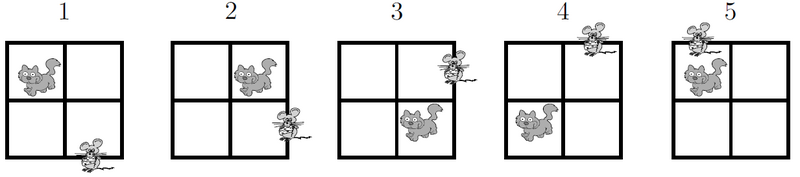
Pick an answer.
AMC 8 2003 problem © Mathematical Association of America (MAA AMC). Reproduced for educational use.
Try it yourself first — the explanation is most useful after you’ve attempted it.
Toolkit + CCSS Solution
Understand
Restated: Four unit squares are arranged in a $2 \times 2$ block. A cat marches clockwise through the four interior squares, one square per move; a mouse marches counterclockwise through the eight exterior edge segments, one segment per move. Both start in the configuration shown in the first figure. After $247$ moves, which of the five labeled diagrams shows their new positions?
Givens: The cat cycles clockwise through $4$ squares — one full loop every $4$ moves; The mouse cycles counterclockwise through $8$ exterior edges — one full loop every $8$ moves; The starting positions match the first figure in the problem; Answer choices (A)–(E) are diagrams showing different cat-square / mouse-edge pairs
Unknowns: Which diagram (A)–(E) matches the cat-and-mouse positions after $247$ moves
Understand
Restated: Four unit squares are arranged in a $2 \times 2$ block. A cat marches clockwise through the four interior squares, one square per move; a mouse marches counterclockwise through the eight exterior edge segments, one segment per move. Both start in the configuration shown in the first figure. After $247$ moves, which of the five labeled diagrams shows their new positions?
Givens: The cat cycles clockwise through $4$ squares — one full loop every $4$ moves; The mouse cycles counterclockwise through $8$ exterior edges — one full loop every $8$ moves; The starting positions match the first figure in the problem; Answer choices (A)–(E) are diagrams showing different cat-square / mouse-edge pairs
Plan
Primary tool: #5 Look for a Pattern
Secondary: #9 Solve an Easier Related Problem, #3 Eliminate Possibilities
The cat and mouse each repeat their orbit on a fixed schedule — Tool #5 (Look for a Pattern) is exactly the "find the 247th term of a repeating cycle" move. The cycles have different lengths ($4$ for the cat, $8$ for the mouse), so we handle each animal as its own easier problem (Tool #9): find the position after the first cycle's worth of moves, then jump to move $247$ using the remainder modulo the cycle length. Finally, Tool #3 (Eliminate Possibilities) checks the five diagrams against the cat square and mouse edge we computed and picks the unique match.
Execute — Answer: A
4.OA.C.5 Step 1 - Find the cat's cycle length.
- The cat moves clockwise around four squares, so it returns to its starting square every $4$ moves.
- The position after move $n$ matches the position after move $n \bmod 4$.
💡 Grade 4 "generate a repeating pattern." Four squares in a loop means four states before the pattern repeats.
4.OA.A.3 Step 2 - Reduce $247$ modulo $4$ to find which square the cat lands on.
- Divide and keep the remainder.
💡 Grade 4 division-with-remainder: after $61$ complete clockwise loops, the cat takes $3$ more steps.
4.OA.C.5 Step 3 - List the cat's cycle and read off position $3$.
- Trace the cat through one full clockwise loop and record where it sits after each move; the $3$rd entry is the answer for our remainder.
💡 The pattern repeats every $4$ moves, and the $3$rd position in the loop is the bottom-right square.
4.OA.C.5 Step 4 - Find the mouse's cycle length the same way.
- The mouse traces eight outer edges counterclockwise, so its orbit has length $8$ and the position after move $n$ matches the position after move $n \bmod 8$.
💡 Eight edges around the outside of the block means eight states in one loop.
4.OA.A.3 Step 5 Reduce $247$ modulo $8$ to find the mouse's edge.
💡 After $30$ complete counterclockwise laps, the mouse advances $7$ more edges from its starting edge.
4.OA.C.5 Step 6 - List the mouse's cycle and read off position $7$.
- Following the eight outer edges counterclockwise, the $7$th edge from the start is the bottom edge of the bottom-left square.
💡 The mouse's loop is $8$ steps long; the $7$th entry sits on the bottom edge of the bottom-left square — one step before completing the lap.
4.OA.A.3 Step 7 - Match the cat-and-mouse positions to the labeled diagrams.
- We need the cat in the bottom-right square and the mouse on the bottom edge of the bottom-left square.
- Scan (A)–(E) and keep the one that matches both conditions; the others fail on the cat's square, the mouse's edge, or both.
💡 Two independent matches narrow five diagrams to one — Tool #3 (Eliminate) finishes the problem.
4.OA.C.5 Find the cat's cycle length. The cat moves clockwise around four squares, so it 4.OA.A.3 Reduce $247$ modulo $4$ to find which square the cat lands on. Divide and keep t 4.OA.C.5 List the cat's cycle and read off position $3$. Trace the cat through one full c 4.OA.C.5 Find the mouse's cycle length the same way. The mouse traces eight outer edges c 4.OA.A.3 Reduce $247$ modulo $8$ to find the mouse's edge. 4.OA.C.5 List the mouse's cycle and read off position $7$. Following the eight outer edge 4.OA.A.3 Match the cat-and-mouse positions to the labeled diagrams. We need the cat in th Review
Reasonableness: Sanity check with a smaller cycle target. After $4$ moves the cat is back where it started, and after $8$ moves the mouse is back where it started — so move $248 = 8 \times 31$ would reset the mouse to its starting edge, and move $244 = 4 \times 61$ would reset the cat to its starting square. Move $247$ is one move before the mouse resets and three moves after the cat's last reset, exactly matching remainders $7$ and $3$. The cat and mouse positions we picked (bottom-right square; bottom edge of bottom-left square) are consistent with a snapshot taken just one tick before both animals would round the southwest corner of their loops, which is the configuration drawn in (A).
Alternative: Tool #3 (Eliminate Possibilities) used on its own: among the five diagrams, only some show the cat in the bottom-right square — eliminate the others on the cat condition alone, then among the survivors, only one shows the mouse on the bottom edge of the bottom-left square. Even without computing the remainders, knowing the two cycles must produce a specific pair of positions reduces the answer to a single diagram once both conditions are checked. This back-substitution style is the standard AMC 8 multiple-choice fallback.
CCSS standards used (min grade 4)
4.OA.C.5Generate a number or shape pattern that follows a given rule (Identifying the cat's $4$-step repeating pattern and the mouse's $8$-step repeating pattern, then listing one full cycle to read off any later position.)4.OA.A.3Solve multistep word problems using the four operations, including problems with remainders (Computing $247 \bmod 4 = 3$ and $247 \bmod 8 = 7$ via division with remainder, then matching the result to the cycle list.)
⭐ Big move numbers in a repeating loop reduce to a small remainder. Once you know the cat repeats every $4$ moves and the mouse repeats every $8$, $247$ collapses to the $3$rd cat position (bottom-right) and the $7$th mouse position (bottom edge of bottom-left) — diagram (A).
⭐ Big move numbers in a repeating loop reduce to a small remainder. Once you know the cat repeats every $4$ moves and the mouse repeats every $8$, $247$ collapses to the $3$rd cat position (bottom-right) and the $7$th mouse position (bottom edge of bottom-left) — diagram (A).
More like this
Same archetype — closest grade level first.