AMC 8 · 2003 · #23
Grade 4 patternProblem
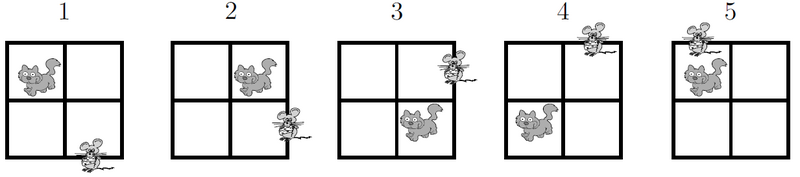
In the pattern below, the cat moves clockwise through the four squares, and the mouse moves counterclockwise through the eight exterior segments of the four squares.
![]()
If the pattern is continued, where would the cat and mouse be after the 247th move?
![]()
Pick an answer.
Toolkit + CCSS Solution
Understand
Restated: Four unit squares are arranged in a $2 \times 2$ block. A cat marches clockwise through the four interior squares, one square per move; a mouse marches counterclockwise through the eight exterior edge segments, one segment per move. Both start in the configuration shown in the first figure. After $247$ moves, which of the five labeled diagrams shows their new positions?
Givens: The cat cycles clockwise through $4$ squares — one full loop every $4$ moves; The mouse cycles counterclockwise through $8$ exterior edges — one full loop every $8$ moves; The starting positions match the first figure in the problem; Answer choices (A)–(E) are diagrams showing different cat-square / mouse-edge pairs
Unknowns: Which diagram (A)–(E) matches the cat-and-mouse positions after $247$ moves
Understand
Restated: Four unit squares are arranged in a $2 \times 2$ block. A cat marches clockwise through the four interior squares, one square per move; a mouse marches counterclockwise through the eight exterior edge segments, one segment per move. Both start in the configuration shown in the first figure. After $247$ moves, which of the five labeled diagrams shows their new positions?
Givens: The cat cycles clockwise through $4$ squares — one full loop every $4$ moves; The mouse cycles counterclockwise through $8$ exterior edges — one full loop every $8$ moves; The starting positions match the first figure in the problem; Answer choices (A)–(E) are diagrams showing different cat-square / mouse-edge pairs
Plan
Primary tool: #5 Look for a Pattern
Secondary: #9 Solve an Easier Related Problem, #3 Eliminate Possibilities
The cat and mouse each repeat their orbit on a fixed schedule — Tool #5 (Look for a Pattern) is exactly the "find the 247th term of a repeating cycle" move. The cycles have different lengths ($4$ for the cat, $8$ for the mouse), so we handle each animal as its own easier problem (Tool #9): find the position after the first cycle's worth of moves, then jump to move $247$ using the remainder modulo the cycle length. Finally, Tool #3 (Eliminate Possibilities) checks the five diagrams against the cat square and mouse edge we computed and picks the unique match.
Execute — Answer: A
4.OA.C.5 Step 1 - Find the cat's cycle length.
- The cat moves clockwise around four squares, so it returns to its starting square every $4$ moves.
- The position after move $n$ matches the position after move $n \bmod 4$.
💡 Grade 4 "generate a repeating pattern." Four squares in a loop means four states before the pattern repeats.
4.OA.A.3 Step 2 - Reduce $247$ modulo $4$ to find which square the cat lands on.
- Divide and keep the remainder.
💡 Grade 4 division-with-remainder: after $61$ complete clockwise loops, the cat takes $3$ more steps.
4.OA.C.5 Step 3 - List the cat's cycle and read off position $3$.
- Trace the cat through one full clockwise loop and record where it sits after each move; the $3$rd entry is the answer for our remainder.
💡 The pattern repeats every $4$ moves, and the $3$rd position in the loop is the bottom-right square.
4.OA.C.5 Step 4 - Find the mouse's cycle length the same way.
- The mouse traces eight outer edges counterclockwise, so its orbit has length $8$ and the position after move $n$ matches the position after move $n \bmod 8$.
💡 Eight edges around the outside of the block means eight states in one loop.
4.OA.A.3 Step 5 Reduce $247$ modulo $8$ to find the mouse's edge.
💡 After $30$ complete counterclockwise laps, the mouse advances $7$ more edges from its starting edge.
4.OA.C.5 Step 6 - List the mouse's cycle and read off position $7$.
- Following the eight outer edges counterclockwise, the $7$th edge from the start is the bottom edge of the bottom-left square.
💡 The mouse's loop is $8$ steps long; the $7$th entry sits on the bottom edge of the bottom-left square — one step before completing the lap.
4.OA.A.3 Step 7 - Match the cat-and-mouse positions to the labeled diagrams.
- We need the cat in the bottom-right square and the mouse on the bottom edge of the bottom-left square.
- Scan (A)–(E) and keep the one that matches both conditions; the others fail on the cat's square, the mouse's edge, or both.
💡 Two independent matches narrow five diagrams to one — Tool #3 (Eliminate) finishes the problem.
4.OA.C.5 Find the cat's cycle length. The cat moves clockwise around four squares, so it 4.OA.A.3 Reduce $247$ modulo $4$ to find which square the cat lands on. Divide and keep t 4.OA.C.5 List the cat's cycle and read off position $3$. Trace the cat through one full c 4.OA.C.5 Find the mouse's cycle length the same way. The mouse traces eight outer edges c 4.OA.A.3 Reduce $247$ modulo $8$ to find the mouse's edge. 4.OA.C.5 List the mouse's cycle and read off position $7$. Following the eight outer edge 4.OA.A.3 Match the cat-and-mouse positions to the labeled diagrams. We need the cat in th Review
Reasonableness: Sanity check with a smaller cycle target. After $4$ moves the cat is back where it started, and after $8$ moves the mouse is back where it started — so move $248 = 8 \times 31$ would reset the mouse to its starting edge, and move $244 = 4 \times 61$ would reset the cat to its starting square. Move $247$ is one move before the mouse resets and three moves after the cat's last reset, exactly matching remainders $7$ and $3$. The cat and mouse positions we picked (bottom-right square; bottom edge of bottom-left square) are consistent with a snapshot taken just one tick before both animals would round the southwest corner of their loops, which is the configuration drawn in (A).
Alternative: Tool #3 (Eliminate Possibilities) used on its own: among the five diagrams, only some show the cat in the bottom-right square — eliminate the others on the cat condition alone, then among the survivors, only one shows the mouse on the bottom edge of the bottom-left square. Even without computing the remainders, knowing the two cycles must produce a specific pair of positions reduces the answer to a single diagram once both conditions are checked. This back-substitution style is the standard AMC 8 multiple-choice fallback.
CCSS standards used (min grade 4)
4.OA.C.5Generate a number or shape pattern that follows a given rule (Identifying the cat's $4$-step repeating pattern and the mouse's $8$-step repeating pattern, then listing one full cycle to read off any later position.)4.OA.A.3Solve multistep word problems using the four operations, including problems with remainders (Computing $247 \bmod 4 = 3$ and $247 \bmod 8 = 7$ via division with remainder, then matching the result to the cycle list.)
⭐ Big move numbers in a repeating loop reduce to a small remainder. Once you know the cat repeats every $4$ moves and the mouse repeats every $8$, $247$ collapses to the $3$rd cat position (bottom-right) and the $7$th mouse position (bottom edge of bottom-left) — diagram (A).