AMC 8 · 2025 · #10

Easy mode Grade 5
📗 View original problem →

Problem

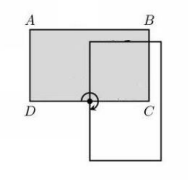
Picture a rectangle ABCDABCD sitting flat on a table. Its longer side ABAB is 55 inches long, and its shorter side ADAD is 33 inches long.

Now find the midpoint of side DCDC — that is, the exact center of the bottom edge. Pin the rectangle down at that point. Then spin the whole rectangle 9090^\circ clockwise around that pin. After the spin, you have a second rectangle.

The two rectangles share part of the table. Some places are covered by only one rectangle. Some places are covered by both at the same time, because they overlap.

What is the total area, in square inches, of the part of the table that is covered by at least one of the two rectangles?
figure

Pick an answer.

(A)
21
(B)
22.25
(C)
23
(D)
23.75
(E)
25
View mode:

Toolkit + CCSS Solution

Understand

Restated: A $5 \times 3$ rectangle $ABCD$ is rotated $90^\circ$ clockwise about the midpoint $M$ of side $DC$, producing a second rectangle that overlaps the first. Find the total area (in square inches) that the union of the two rectangles covers.

Givens: $ABCD$ is a rectangle with $AB = 5$ in and $AD = 3$ in; The rotation is $90^\circ$ clockwise about $M$, the midpoint of $DC$; Side $DC = AB = 5$, so $MD = MC = 2.5$ in; Answer choices: (A) $21$, (B) $22.25$, (C) $23$, (D) $23.75$, (E) $25$

Unknowns: The total area covered by the union of the original and rotated rectangles

Understand

Restated: A $5 \times 3$ rectangle $ABCD$ is rotated $90^\circ$ clockwise about the midpoint $M$ of side $DC$, producing a second rectangle that overlaps the first. Find the total area (in square inches) that the union of the two rectangles covers.

Givens: $ABCD$ is a rectangle with $AB = 5$ in and $AD = 3$ in; The rotation is $90^\circ$ clockwise about $M$, the midpoint of $DC$; Side $DC = AB = 5$, so $MD = MC = 2.5$ in; Answer choices: (A) $21$, (B) $22.25$, (C) $23$, (D) $23.75$, (E) $25$

Plan

Primary tool: #1 Draw a Diagram

Secondary: #7 Identify Subproblems, #10 Create a Physical Representation

Tool #1 (Draw a Diagram) is the natural first move because the problem is about positions of two overlapping rectangles after a rotation — sketching $ABCD$, marking the midpoint $M$, and drawing the rotated copy makes the overlap visible. Tool #10 (Physical Representation) is a great backup if visualization is shaky — cutting a $5 \times 3$ paper rectangle, marking the midpoint of the long side, and rotating it $90^\circ$ shows immediately that the overlap is a small square. Tool #7 (Identify Subproblems) then breaks the question into three clean pieces: (i) area of one rectangle, (ii) shape and area of the overlap, (iii) combine via Inclusion-Exclusion: Total $=$ Area$_1 +$ Area$_2 -$ Overlap.

Execute — Answer: D

#1 Draw a Diagram 3.G.A.2 Step 1
  • Sketch the original rectangle $ABCD$ with $AB = 5$ on the top, $DC = 5$ on the bottom, and $AD = 3$ on the left side.
  • Mark $M$, the midpoint of $DC$, so $MD = MC = 2.5$ in.
  • This picture anchors everything that follows.
$$MD = MC = \tfrac{5}{2} = 2.5 \text{ in}$$

💡 Splitting a side in half and labeling the midpoint is Grade 3 partitioning — no formulas needed yet.

#7 Identify Subproblems 4.MD.A.3 Step 2
  • Compute the area of one rectangle using length $\times$ width.
  • Each rectangle covers $5 \times 3 = 15$ square inches.
$$\text{Area}_{\text{one}} = 5 \times 3 = 15 \text{ in}^2$$

💡 Multiplying length by width to get a rectangle's area is the Grade 4 area formula.

#10 Create a Physical Representation 1.G.A.2 Step 3
  • Now draw (or fold a paper copy and rotate it) the rotated rectangle.
  • Pinning the paper at $M$ and turning it $90^\circ$ clockwise swings the original right-half (the $2.5 \times 3$ piece from $M$ to $C$) so that it now sticks out to the right of $M$, and the original top edge near $M$ swings down to lie along the line through $M$.
  • The picture shows the overlap is bounded by $M$, a $2.5$-inch run rightward along the bottom, a $2.5$-inch run upward, and back to $M$ — a square.
Overlap is a square with side $2.5 \text{ in}$

💡 Physically rotating the paper makes the overlapping piece obvious — composing/decomposing shapes is a Grade 1 skill.

#7 Identify Subproblems 5.NBT.B.7 Step 4
  • Find the overlap area.
  • The overlap is a square of side $2.5$ in, so its area is $2.5 \times 2.5$.
$$\text{Overlap} = 2.5 \times 2.5 = 6.25 \text{ in}^2$$

💡 Multiplying two decimals to hundredths ($2.5 \times 2.5 = 6.25$) is a Grade 5 decimal-operation skill.

#7 Identify Subproblems 5.NBT.B.7 Step 5

Combine using Inclusion-Exclusion: when two shapes overlap, the total covered area is the sum of the two areas minus the overlap (otherwise the overlap is counted twice).

$$\text{Total} = 15 + 15 - 6.25 = 30 - 6.25 = 23.75 \text{ in}^2 \;\Rightarrow\; \textbf{(D)}$$

💡 Subtracting the overlap once removes the double count — the arithmetic $30 - 6.25$ is Grade 5 decimal subtraction.

[1] #1 3.G.A.2 Sketch the original rectangle $ABCD$ with $AB = 5$ on the top, $DC = 5$ on the b
[2] #7 4.MD.A.3 Compute the area of one rectangle using length $\times$ width. Each rectangle co
[3] #10 1.G.A.2 Now draw (or fold a paper copy and rotate it) the rotated rectangle. Pinning the
[4] #7 5.NBT.B.7 Find the overlap area. The overlap is a square of side $2.5$ in, so its area is
[5] #7 5.NBT.B.7 Combine using Inclusion-Exclusion: when two shapes overlap, the total covered ar

Review

Reasonableness: Each rectangle alone covers $15$ in$^2$, so the union must be more than $15$ but less than $2 \times 15 = 30$. Our answer $23.75$ sits comfortably between, and the overlap of $6.25$ is exactly $\tfrac{1}{2} \times 2.5 \times 5 = 6.25$ — half of the $2.5 \times 5$ "half rectangle," which fits the geometry. Choice (D) is the unique option in that range matching $30 - 6.25$.

Alternative: Tool #17 (Visualize Spatial Relationships) with a coordinate grid: place $M$ at $(0,0)$, so the original rectangle occupies $-2.5 \le x \le 2.5$, $0 \le y \le 3$, and the rotated one occupies $0 \le x \le 3$, $-2.5 \le y \le 2.5$. The overlap is the box $0 \le x \le 2.5$, $0 \le y \le 2.5$, area $6.25$ — same answer, $23.75$ in$^2$.

CCSS standards used (min grade 5)

  • 1.G.A.2 Compose two-dimensional shapes or three-dimensional shapes (Recognizing that rotating the rectangle creates an overlapping region built from simple shapes — the overlap is a square pieced together from the corners of both rectangles.)
  • 3.G.A.2 Partition shapes into equal parts with equal areas (Locating the midpoint $M$ of side $DC$ by splitting the $5$-inch side into two equal $2.5$-inch parts.)
  • 4.MD.A.3 Apply area and perimeter formulas for rectangles in real-world problems (Computing the area of each rectangle as $5 \times 3 = 15$ in$^2$.)
  • 5.NBT.B.7 Add, subtract, multiply, and divide decimals to hundredths (Multiplying $2.5 \times 2.5 = 6.25$ to get the overlap area, and subtracting $30 - 6.25 = 23.75$ for the final answer.)

⭐ This AMC 8 problem only needs Grade 5 decimal multiplication you already know — once you see the overlap is a tiny 2.5-by-2.5 square, the rest is just $15 + 15 - 6.25$!

⭐ This AMC 8 problem only needs Grade 5 decimal multiplication you already know — once you see the overlap is a tiny 2.5-by-2.5 square, the rest is just $15 + 15 - 6.25$!