AMC 8 · 2025 · #10
Grade 5 geometry-2dProblem
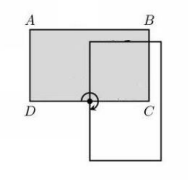
In the figure below, is a rectangle with sides of length inches and = 3 inches. Rectangle is rotated clockwise around the midpoint of side to give a second rectangle. What is the total area, in square inches, covered by the two overlapping rectangles?
Pick an answer.
Toolkit + CCSS Solution
Understand
Restated: A $5 \times 3$ rectangle $ABCD$ is rotated $90^\circ$ clockwise about the midpoint $M$ of side $DC$, producing a second rectangle that overlaps the first. Find the total area (in square inches) that the union of the two rectangles covers.
Givens: $ABCD$ is a rectangle with $AB = 5$ in and $AD = 3$ in; The rotation is $90^\circ$ clockwise about $M$, the midpoint of $DC$; Side $DC = AB = 5$, so $MD = MC = 2.5$ in; Answer choices: (A) $21$, (B) $22.25$, (C) $23$, (D) $23.75$, (E) $25$
Unknowns: The total area covered by the union of the original and rotated rectangles
Understand
Restated: A $5 \times 3$ rectangle $ABCD$ is rotated $90^\circ$ clockwise about the midpoint $M$ of side $DC$, producing a second rectangle that overlaps the first. Find the total area (in square inches) that the union of the two rectangles covers.
Givens: $ABCD$ is a rectangle with $AB = 5$ in and $AD = 3$ in; The rotation is $90^\circ$ clockwise about $M$, the midpoint of $DC$; Side $DC = AB = 5$, so $MD = MC = 2.5$ in; Answer choices: (A) $21$, (B) $22.25$, (C) $23$, (D) $23.75$, (E) $25$
Plan
Primary tool: #1 Draw a Diagram
Secondary: #7 Identify Subproblems, #10 Create a Physical Representation
Tool #1 (Draw a Diagram) is the natural first move because the problem is about positions of two overlapping rectangles after a rotation — sketching $ABCD$, marking the midpoint $M$, and drawing the rotated copy makes the overlap visible. Tool #10 (Physical Representation) is a great backup if visualization is shaky — cutting a $5 \times 3$ paper rectangle, marking the midpoint of the long side, and rotating it $90^\circ$ shows immediately that the overlap is a small square. Tool #7 (Identify Subproblems) then breaks the question into three clean pieces: (i) area of one rectangle, (ii) shape and area of the overlap, (iii) combine via Inclusion-Exclusion: Total $=$ Area$_1 +$ Area$_2 -$ Overlap.
Execute — Answer: D
3.G.A.2 Step 1 - Sketch the original rectangle $ABCD$ with $AB = 5$ on the top, $DC = 5$ on the bottom, and $AD = 3$ on the left side.
- Mark $M$, the midpoint of $DC$, so $MD = MC = 2.5$ in.
- This picture anchors everything that follows.
💡 Splitting a side in half and labeling the midpoint is Grade 3 partitioning — no formulas needed yet.
4.MD.A.3 Step 2 - Compute the area of one rectangle using length $\times$ width.
- Each rectangle covers $5 \times 3 = 15$ square inches.
💡 Multiplying length by width to get a rectangle's area is the Grade 4 area formula.
1.G.A.2 Step 3 - Now draw (or fold a paper copy and rotate it) the rotated rectangle.
- Pinning the paper at $M$ and turning it $90^\circ$ clockwise swings the original right-half (the $2.5 \times 3$ piece from $M$ to $C$) so that it now sticks out to the right of $M$, and the original top edge near $M$ swings down to lie along the line through $M$.
- The picture shows the overlap is bounded by $M$, a $2.5$-inch run rightward along the bottom, a $2.5$-inch run upward, and back to $M$ — a square.
💡 Physically rotating the paper makes the overlapping piece obvious — composing/decomposing shapes is a Grade 1 skill.
5.NBT.B.7 Step 4 - Find the overlap area.
- The overlap is a square of side $2.5$ in, so its area is $2.5 \times 2.5$.
💡 Multiplying two decimals to hundredths ($2.5 \times 2.5 = 6.25$) is a Grade 5 decimal-operation skill.
5.NBT.B.7 Step 5 Combine using Inclusion-Exclusion: when two shapes overlap, the total covered area is the sum of the two areas minus the overlap (otherwise the overlap is counted twice).
💡 Subtracting the overlap once removes the double count — the arithmetic $30 - 6.25$ is Grade 5 decimal subtraction.
3.G.A.2 Sketch the original rectangle $ABCD$ with $AB = 5$ on the top, $DC = 5$ on the b 4.MD.A.3 Compute the area of one rectangle using length $\times$ width. Each rectangle co 1.G.A.2 Now draw (or fold a paper copy and rotate it) the rotated rectangle. Pinning the 5.NBT.B.7 Find the overlap area. The overlap is a square of side $2.5$ in, so its area is 5.NBT.B.7 Combine using Inclusion-Exclusion: when two shapes overlap, the total covered ar Review
Reasonableness: Each rectangle alone covers $15$ in$^2$, so the union must be more than $15$ but less than $2 \times 15 = 30$. Our answer $23.75$ sits comfortably between, and the overlap of $6.25$ is exactly $\tfrac{1}{2} \times 2.5 \times 5 = 6.25$ — half of the $2.5 \times 5$ "half rectangle," which fits the geometry. Choice (D) is the unique option in that range matching $30 - 6.25$.
Alternative: Tool #17 (Visualize Spatial Relationships) with a coordinate grid: place $M$ at $(0,0)$, so the original rectangle occupies $-2.5 \le x \le 2.5$, $0 \le y \le 3$, and the rotated one occupies $0 \le x \le 3$, $-2.5 \le y \le 2.5$. The overlap is the box $0 \le x \le 2.5$, $0 \le y \le 2.5$, area $6.25$ — same answer, $23.75$ in$^2$.
CCSS standards used (min grade 5)
1.G.A.2Compose two-dimensional shapes or three-dimensional shapes (Recognizing that rotating the rectangle creates an overlapping region built from simple shapes — the overlap is a square pieced together from the corners of both rectangles.)3.G.A.2Partition shapes into equal parts with equal areas (Locating the midpoint $M$ of side $DC$ by splitting the $5$-inch side into two equal $2.5$-inch parts.)4.MD.A.3Apply area and perimeter formulas for rectangles in real-world problems (Computing the area of each rectangle as $5 \times 3 = 15$ in$^2$.)5.NBT.B.7Add, subtract, multiply, and divide decimals to hundredths (Multiplying $2.5 \times 2.5 = 6.25$ to get the overlap area, and subtracting $30 - 6.25 = 23.75$ for the final answer.)
⭐ This AMC 8 problem only needs Grade 5 decimal multiplication you already know — once you see the overlap is a tiny 2.5-by-2.5 square, the rest is just $15 + 15 - 6.25$!