AMC 8 · 2003 · #24
Grade 8 rate-ratioProblem
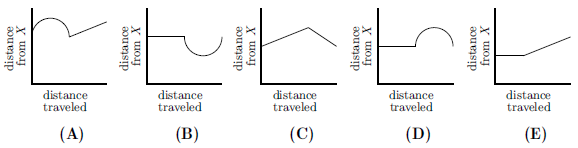
A ship travels from point to point along a semicircular path, centered at Island . Then it travels along a straight path from to . Which of these graphs best shows the ship's distance from Island as it moves along its course?

Pick an answer.
Toolkit + CCSS Solution
Understand
Restated: A ship sails from $A$ to $B$ along a semicircle centered at Island $X$, then sails in a straight line from $B$ to $C$. Pick the graph that best shows the ship's distance from $X$ over the whole trip. From the figure, $X$ is the center of the semicircle and $C$ is the point above $X$ where the radius going up meets the circle (so $XB = XC$ and angle $BXC = 90^\circ$).
Givens: Leg 1: $A \to B$ is a semicircle centered at $X$; Leg 2: $B \to C$ is a straight segment; The figure shows $B$ on the right of $X$ and $C$ directly above $X$, both at radius $r$; Answer choices: five candidate graphs labeled (A)-(E) of distance from $X$ vs. time
Unknowns: Which graph matches the ship's distance from $X$ over the whole trip
Understand
Restated: A ship sails from $A$ to $B$ along a semicircle centered at Island $X$, then sails in a straight line from $B$ to $C$. Pick the graph that best shows the ship's distance from $X$ over the whole trip. From the figure, $X$ is the center of the semicircle and $C$ is the point above $X$ where the radius going up meets the circle (so $XB = XC$ and angle $BXC = 90^\circ$).
Givens: Leg 1: $A \to B$ is a semicircle centered at $X$; Leg 2: $B \to C$ is a straight segment; The figure shows $B$ on the right of $X$ and $C$ directly above $X$, both at radius $r$; Answer choices: five candidate graphs labeled (A)-(E) of distance from $X$ vs. time
Plan
Primary tool: #1 Draw a Diagram
Secondary: #7 Identify Subproblems, #9 Solve an Easier Related Problem
The problem is about positions, paths, and a graph — exactly what Tool #1 (Draw a Diagram) is for. Putting $X$ at the origin turns the question into something we can measure. Tool #7 (Identify Subproblems) tells us to handle leg $A \to B$ and leg $B \to C$ separately, because they obey completely different rules (circle vs. straight line). Tool #9 (Solve an Easier Related Problem) lets us sidestep messy algebra on the second leg: instead of computing the distance at every moment, we only check the start, the middle, and the end of $BC$, which is enough to pin down the shape of the graph.
Execute — Answer: B
6.G.A.3 Step 1 - Place $X$ at the origin and read the figure.
- The semicircle has some radius $r$, $B = (r, 0)$, and from the figure $C = (0, r)$.
- Now distance from $X$ is just distance from the origin.
💡 Grade 6 coordinate-plane geometry: choosing axes so the key point sits at the origin makes every distance easy to read.
7.G.B.4 Step 2 - Leg 1 ($A \to B$): every point on a circle centered at $X$ is the same distance from $X$.
- So while the ship rides the semicircle, the distance stays equal to the radius.
💡 Grade 7 circle facts: the radius is the defining constant of a circle, so a path along the circle cannot change distance from the center.
8.F.B.5 Step 3 - On the graph, leg 1 is therefore a flat horizontal segment at height $r$.
- That alone eliminates any choice whose first piece is not flat.
💡 Grade 8 graph reading: "constant value" on a real situation translates to "horizontal" on a graph of that value vs. time.
6.G.A.3 Step 4 - Leg 2 ($B \to C$): instead of tracking every point, sample three: the start $B$, the midpoint $M$ of $BC$, and the end $C$.
- This is the easier sub-problem.
💡 Grade 6 coordinate work: the midpoint of a segment is the average of its endpoints' coordinates.
8.G.B.8 Step 5 - Compute the three distances using the Pythagorean theorem.
- Both endpoints sit at distance $r$ from $X$; the midpoint sits closer.
💡 Grade 8 Pythagorean distance formula: distance from the origin to $(a,b)$ is $\sqrt{a^2 + b^2}$.
8.F.B.5 Step 6 - So on leg 2 the distance starts at $r$, dips to about $0.71\,r$ in the middle, and rises back to $r$ — a symmetric dip.
- It is also smooth (no corner), because the distance from a fixed point to a sliding point on a line changes via a square-root expression, not two straight pieces.
- That rules out the V-shaped option made of straight lines.
💡 Grade 8: a V-shape on a graph means a linear change with a sudden corner. Distance from a point to a moving line-point is nonlinear, so the graph curves.
8.F.B.5 Step 7 - Stitch the two pieces together: horizontal segment at height $r$, then a smooth symmetric dip that returns to height $r$.
- The only answer choice with that exact shape is (B).
💡 Grade 8 graph matching: combine the qualitative features of each leg (flat, then curved-dip) and find the one option whose silhouette matches.
6.G.A.3 Place $X$ at the origin and read the figure. The semicircle has some radius $r$, 7.G.B.4 Leg 1 ($A \to B$): every point on a circle centered at $X$ is the same distance 8.F.B.5 On the graph, leg 1 is therefore a flat horizontal segment at height $r$. That a 6.G.A.3 Leg 2 ($B \to C$): instead of tracking every point, sample three: the start $B$, 8.G.B.8 Compute the three distances using the Pythagorean theorem. Both endpoints sit at 8.F.B.5 So on leg 2 the distance starts at $r$, dips to about $0.71\,r$ in the middle, a 8.F.B.5 Stitch the two pieces together: horizontal segment at height $r$, then a smooth Review
Reasonableness: Both end-of-trip distances should match the radius, and they do: the ship starts at $A$ (distance $r$), stays at distance $r$ along the whole semicircle, ends leg 2 at $C$ (distance $r$ again). The minimum distance on leg 2 is $r/\sqrt{2} \approx 0.71\,r$, which is less than $r$ but still positive — consistent with the smooth dip in graph (B). The V-shape in (C) would mean the distance changes at a constant rate on each side of the minimum, which is wrong because the distance from a fixed point to a sliding point on a line is not linear.
Alternative: Tool #13 (Convert to Algebra): parameterize leg 2 as $(r - rt,\, rt)$ for $t \in [0,1]$. The distance to $X$ is $\sqrt{(r-rt)^2 + (rt)^2} = r\sqrt{2t^2 - 2t + 1}$. The expression under the root is a parabola with vertex at $t = \tfrac{1}{2}$, giving minimum $r\sqrt{1/2} = r/\sqrt{2}$. The square root of a parabola is a smooth curved dip — same conclusion, graph (B), without the sampling shortcut.
CCSS standards used (min grade 8)
6.G.A.3Draw polygons in the coordinate plane given coordinates for the vertices; use coordinates to find lengths and locations (Placing $X$ at the origin and labeling $A,B,C,M$ with coordinates so distances can be read off the plane.)7.G.B.4Know the formulas for the area and circumference of a circle and use them; give an informal derivation of the relationship between the circumference and area of a circle (Using the defining property of a circle — every point on it is the same distance (the radius) from the center — to conclude leg 1 has constant distance $r$ from $X$.)8.G.B.8Apply the Pythagorean Theorem to find the distance between two points in a coordinate system (Computing distances from $X = (0,0)$ to points on segment $BC$, including $XM = \sqrt{(r/2)^2 + (r/2)^2} = r/\sqrt{2}$.)8.F.B.5Describe qualitatively the functional relationship between two quantities by analyzing a graph (e.g., where the function is increasing or decreasing, linear or nonlinear) (Translating the physical journey into the shape of the distance-vs-time graph: a constant (horizontal) piece followed by a smooth, nonlinear, symmetric dip — matching graph (B).)
⭐ Whenever a ship rides a circle around a point, its distance to that point cannot change. Whenever it cuts across in a straight line, the distance changes smoothly — never in a sharp V. Spotting those two shapes turns this AMC 8 problem into a Grade 8 graph-reading exercise.