AMC 8 · 2007 · #16
Grade 8 geometry-2dProblem
Amanda Reckonwith draws five circles with radii and . Then for each circle she plots the point ,
where is its circumference and is its area. Which of the
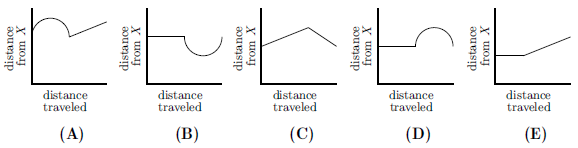
following could be her graph?
Pick an answer.
Toolkit + CCSS Solution
Understand
Restated: For each radius $r = 1, 2, 3, 4, 5$, Amanda plots the point $(C, A)$, where $C = 2\pi r$ is the circle's circumference and $A = \pi r^2$ is its area. Which of the five scatter plots could be her graph?
Givens: Five radii: $r = 1, 2, 3, 4, 5$; $x$-coordinate of each point is $C = 2\pi r$; $y$-coordinate of each point is $A = \pi r^2$; Answer choices: (A) y-values $2, 4, 7, 11, 16$ — gaps grow; (B) y-values $9, 6, 6, 9, 15$ — dips then rises; (C) y-values $2, 6, 8, 6, 2$ — inverted-U; (D) y-values $2, 5, 8, 11, 14$ — linear; (E) y-values $15, 10, 6, 3, 1$ — strictly decreasing
Unknowns: Which scatter plot matches the actual $(C, A)$ values for the five circles
Understand
Restated: For each radius $r = 1, 2, 3, 4, 5$, Amanda plots the point $(C, A)$, where $C = 2\pi r$ is the circle's circumference and $A = \pi r^2$ is its area. Which of the five scatter plots could be her graph?
Givens: Five radii: $r = 1, 2, 3, 4, 5$; $x$-coordinate of each point is $C = 2\pi r$; $y$-coordinate of each point is $A = \pi r^2$; Answer choices: (A) y-values $2, 4, 7, 11, 16$ — gaps grow; (B) y-values $9, 6, 6, 9, 15$ — dips then rises; (C) y-values $2, 6, 8, 6, 2$ — inverted-U; (D) y-values $2, 5, 8, 11, 14$ — linear; (E) y-values $15, 10, 6, 3, 1$ — strictly decreasing
Plan
Primary tool: #5 Look for a Pattern
Secondary: #2 Make an Organized List
Tool #5 (Look for a Pattern) is the right fit because the question is really asking how the area pattern behaves as the circumference grows steadily. Circumference grows by the same amount each time ($+2\pi$ per unit of radius), but area grows by the differences of consecutive squares — $3, 5, 7, 9$ — so the gaps between $y$-values must keep getting larger. Tool #2 (Make an Organized List) lets us tabulate the actual $C$ and $A$ values side by side so the growth pattern is visible. Once we see "equal $x$-steps, growing $y$-steps," only one choice can fit.
Execute — Answer: A
7.G.B.4 Step 1 - List $C$ and $A$ for each radius using $C = 2\pi r$ and $A = \pi r^2$.
- Keep $\pi$ as a common factor so the pattern is easy to read.
💡 The Grade 7 circle formulas plug in directly: $C$ is linear in $r$, $A$ is the square of $r$ (times $\pi$).
6.RP.A.1 Step 2 - Check the $x$-coordinates.
- The $C$-values $2\pi, 4\pi, 6\pi, 8\pi, 10\pi$ are equally spaced — each one is $2\pi$ more than the previous.
- So the five points must sit at evenly spaced $x$-positions on the graph.
💡 Doubling, tripling, ... the radius doubles, triples, ... the circumference. Steady step.
6.EE.A.1 Step 3 - Check the $y$-coordinates.
- The $A$-values $\pi, 4\pi, 9\pi, 16\pi, 25\pi$ are the perfect squares times $\pi$.
- The jumps between them are $3\pi, 5\pi, 7\pi, 9\pi$ — each gap is larger than the last.
- So the points rise, AND they rise by more each time (concave-up shape).
💡 Consecutive square differences are the odd numbers $3, 5, 7, 9$ — a classic growing pattern.
8.F.A.3 Step 4 - Match the pattern "equal $x$-spacing, growing $y$-gaps" to the choices.
- (B), (C), (E) fail because their $y$-values are not strictly increasing.
- (D) has $y$-gaps $3, 3, 3, 3$ — constant, which would mean $A$ is linear in $C$, but $A$ grows like $r^2$, not like $r$.
- Only (A) has $y$-gaps $2, 3, 4, 5$ — strictly growing, exactly the concave-up shape forced by squaring.
💡 A linear graph has equal step-ups; a quadratic graph has step-ups that keep growing. (A) shows the quadratic shape.
7.G.B.4 List $C$ and $A$ for each radius using $C = 2\pi r$ and $A = \pi r^2$. Keep $\pi 6.RP.A.1 Check the $x$-coordinates. The $C$-values $2\pi, 4\pi, 6\pi, 8\pi, 10\pi$ are eq 6.EE.A.1 Check the $y$-coordinates. The $A$-values $\pi, 4\pi, 9\pi, 16\pi, 25\pi$ are th 8.F.A.3 Match the pattern "equal $x$-spacing, growing $y$-gaps" to the choices. (B), (C) Review
Reasonableness: Sanity check with $\pi \approx 3.14$. Exact $(C, A)$ values are approximately $(6.3, 3.1),\ (12.6, 12.6),\ (18.8, 28.3),\ (25.1, 50.3),\ (31.4, 78.5)$. The $A$-values $3.1, 12.6, 28.3, 50.3, 78.5$ accelerate upward — gaps $9.5, 15.7, 22.0, 28.3$. That is the concave-up curve in choice (A), not the straight line in (D). Also, since $A = \dfrac{C^2}{4\pi}$, plotting $A$ against $C$ traces a parabola opening upward — and (A) is the only choice whose five dots lie on such a curve.
Alternative: Tool #10 (Find a Related Problem): substitute $r = \dfrac{C}{2\pi}$ into $A = \pi r^2$. That gives $A = \pi \cdot \dfrac{C^2}{4\pi^2} = \dfrac{C^2}{4\pi}$, the equation of a parabola in $C$. A parabola through the origin opening upward is concave up and strictly increasing on the right side, instantly matching choice (A) without computing each point.
CCSS standards used (min grade 8)
7.G.B.4Know the formulas for the area and circumference of a circle and use them to solve problems (Computing $C = 2\pi r$ and $A = \pi r^2$ for each radius $r = 1, 2, 3, 4, 5$.)6.RP.A.1Understand the concept of a ratio and use ratio language to describe a ratio relationship (Noticing that $C$ grows in equal $2\pi$ steps, so the $x$-coordinates are evenly spaced.)6.EE.A.1Write and evaluate numerical expressions involving whole-number exponents (Evaluating the squares $1^2, 2^2, 3^2, 4^2, 5^2$ to get the $A$-values $\pi, 4\pi, 9\pi, 16\pi, 25\pi$.)8.F.A.3Interpret the equation $y = mx + b$ as defining a linear function; give examples of functions that are not linear (Distinguishing the quadratic growth pattern of $A$ (gaps $3\pi, 5\pi, 7\pi, 9\pi$) from a linear graph with constant gaps, so the correct choice (A) is the non-linear one.)
⭐ Circumference $C = 2\pi r$ grows steadily, but area $A = \pi r^2$ grows by the odd numbers $3\pi, 5\pi, 7\pi, 9\pi$ — so the graph must rise faster and faster. That concave-up shape is choice (A).